



World’s Most Transformative Inventions
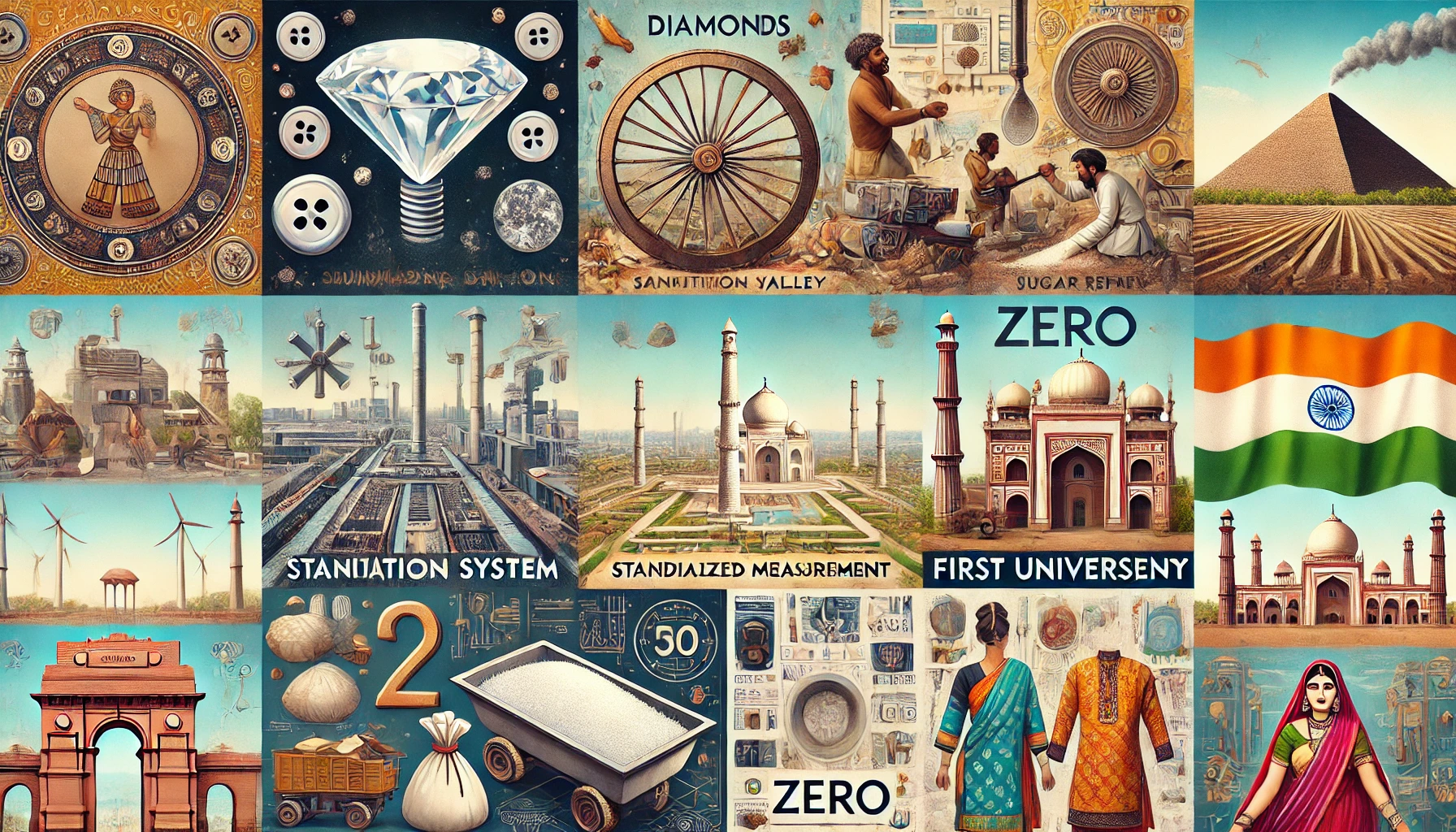
India, a land of ancient wisdom and unparalleled innovation, has produced some of the world’s most transformative inventions. While many of these contributions remain unknown or underappreciated, their impact on modern civilization is undeniable. From groundbreaking scientific discoveries to essential everyday utilities, India’s genius has shaped the world we live in today. Let’s explore 10 revolutionary Indian inventions that have forever altered human history.
1. Diamonds – The First Gems of the World
Diamonds are synonymous with luxury, but did you know that India was the first and sole source of diamonds for nearly two millennia? As early as the 4th century BCE, diamonds were mined and traded in India. The famed Golconda mines produced some of the world’s most legendary diamonds, including the Koh-i-Noor and the Hope Diamond. Until diamonds were later discovered in Brazil and Africa, India was the ultimate supplier of these dazzling gems.
2. The Humble Yet Essential Button
The simple button, a fundamental part of modern clothing, has its roots in the Indus Valley Civilization around 2000 BCE. Initially crafted from seashells, these buttons were more than mere fasteners; they served as ornaments and status symbols. Today, the global fashion industry thrives on this tiny invention, with buttons remaining an essential element of design and functionality.
3. The World’s First Sanitation System
Long before sophisticated urban planning became a norm, the Indus Valley Civilization had already implemented an advanced drainage and sanitation system. Cities like Mohenjodaro and Harappa featured well-planned drainage channels, water supply systems, and even flush toilets. The concept of waste management and sanitation, which Europe only developed centuries later, was an Indian innovation thousands of years ago.
4. The Sweet Revolution – Sugar Refinement
While sugarcane was consumed in its raw form across ancient civilizations, it was in India that the process of crystallizing sugar was first developed. Ancient Sanskrit texts mention the art of refining sugar, which eventually spread to Persia and beyond. The very word “sugar” originates from the Sanskrit term “Sakara.” This discovery revolutionized food habits globally, making sweets an integral part of diets worldwide.
5. Metallurgy Mastery – The Rust-Free Iron Pillar
India’s metallurgical advancements date back over 7,000 years, and the proof stands tall even today. The Iron Pillar of Delhi, dating back to the Gupta Empire (circa 400 CE), has remained rust-free despite being exposed to the elements for over 1,600 years. This remarkable feat of ancient Indian metallurgy highlights the advanced scientific understanding of metal alloys, a skill far ahead of its time.
6. The Invention of Standardized Measurement – Rulers and Scales
The people of the Indus Valley Civilization developed standardized measuring tools, including ivory rulers and weighing scales, as early as 1500 BCE. These instruments ensured uniform construction techniques, as evident in the precisely cut bricks used across the entire region. This ancient innovation laid the foundation for modern engineering and architecture.
7. Cotton and Textile Revolution
India pioneered the cultivation and weaving of cotton, dating back nearly 7,000 years. The skill of Indian weavers was so exceptional that Indian muslin was once known as “woven air.” The textile industry became a massive economic force, with Indian fabrics being exported globally. The tradition of handwoven textiles continues to thrive, making India a global leader in cotton production.
8. The World’s First University – Takshashila
Education has always been a cornerstone of Indian civilization. The world’s first university, Takshashila, was established in India around the 5th century BCE. It housed over 10,000 students from across the world and offered 60 disciplines, ranging from medicine and mathematics to astronomy and philosophy. The legacy of Indian education continues with institutions like Nalanda and modern-day IITs.
9. The Invention of Zero – The Cornerstone of Mathematics
The concept of zero, which forms the foundation of modern mathematics, was an Indian invention. The mathematician Aryabhata and later Brahmagupta formalized the numerical value of zero, which led to the development of algebra, calculus, and modern computing. Without this fundamental invention, the digital world as we know it would not exist.
10. Yoga – The Ultimate Science of the Mind and Body
Yoga, a practice that harmonizes the mind, body, and spirit, was born in India over 5,000 years ago. Ancient texts like the Rigveda and the Upanishads mention yogic practices, and Patanjali’s Yoga Sutras further formalized them. Today, yoga is a global phenomenon, offering holistic well-being to millions worldwide, proving that ancient Indian wisdom is timeless.
Conclusion
India’s contributions to the world extend far beyond these ten inventions. From pioneering medical procedures like plastic surgery to innovations in astronomy and navigation, India’s scientific and cultural legacy is rich and enduring. Despite periods of colonization and setbacks, India continues to be a powerhouse of innovation, proving that its past achievements are only the foundation for a brighter future.
As the world moves forward, it’s crucial to recognize and celebrate these revolutionary Indian inventions that have shaped civilization. India’s genius is not just a part of history but a path guiding the future!


